
The Time Machine
A ramble about how interconnected life is.

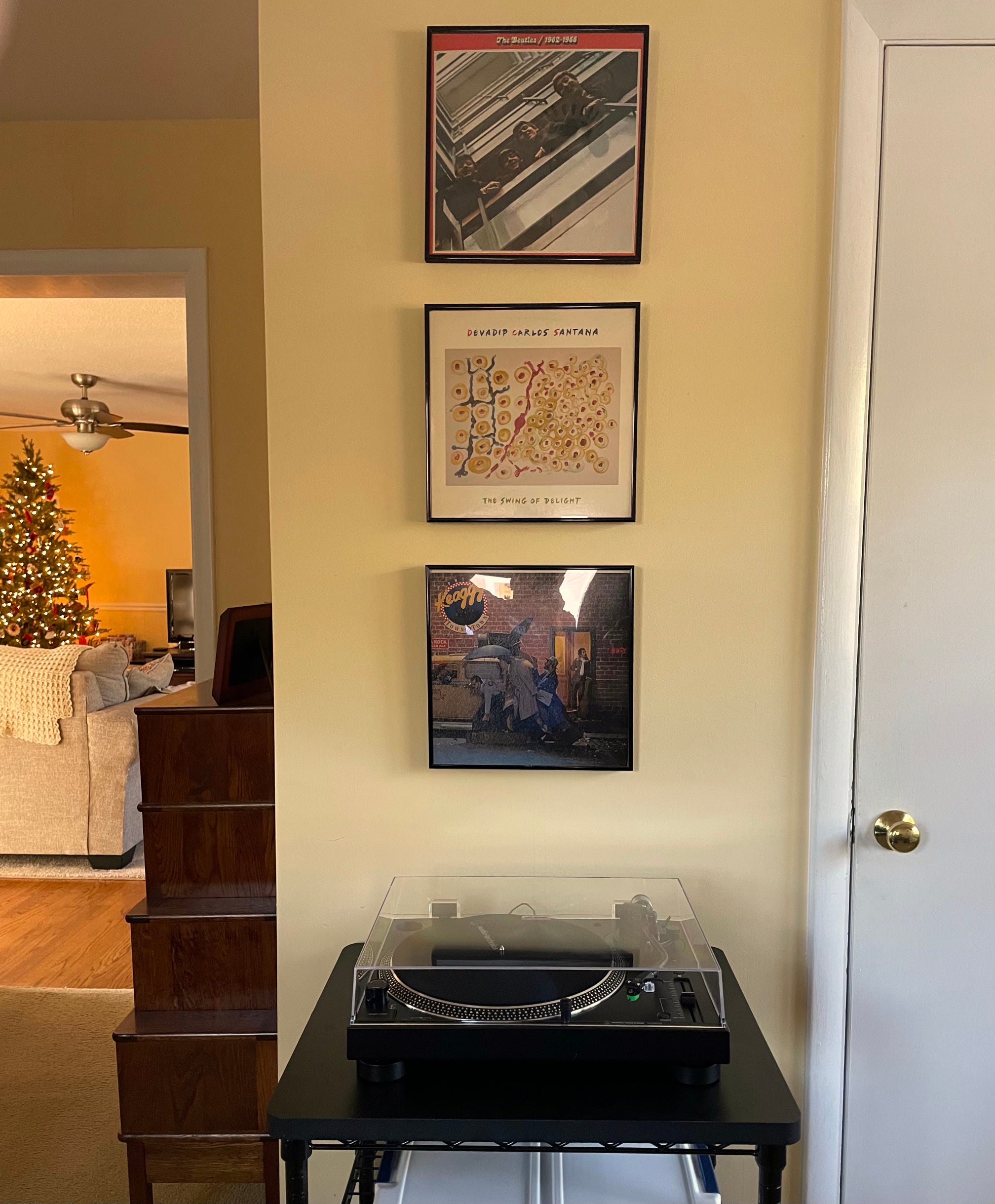
I was born in 1960. At the time, music came on vinyl discs that crackled and popped when you played them, or over the airwaves on the radio. By the time I was buying music, 8-track tapes were popular for portable music playing. My first car had an 8-track player—once I installed it. But vinyl was still the standard way to play music in most homes.
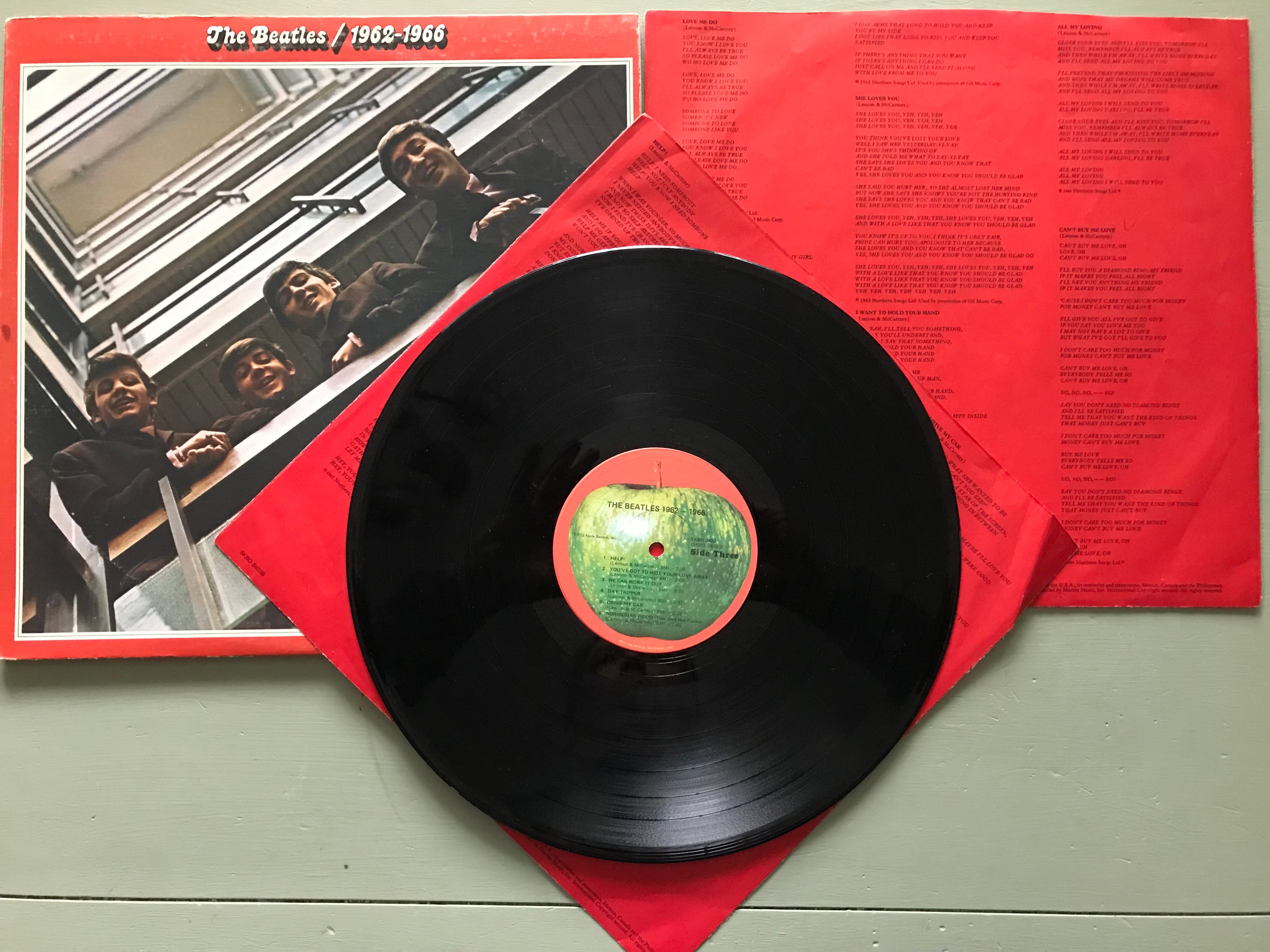
I grew up on what is now called “classic rock.” It was all new at the time, of course, and it seemed like every day a great new song was released. The first album I bought with my own money was The Beatles/1962-1966, which you can see in the photograph at the top of this story (and below.)
Along with the rock and pop music of the day, which I loved, I started discovering “Contemporary Christian Music,” which was music with a gospel message set to contemporary music styles. One of my favorite groups was the Imperials. Their songs were lyrically great and musically catchy, but it was their new singer, Russ Taff, who truly made me a fan. He is one of my all-time favorite male singers with a powerful voice that could knock down walls. But it is not just his power, he sings with such emotion and conviction that it grabs your very soul.
In the early 1980s, the CD came out. Cassettes were around by then, but CDs had far better sound quality and were “random access” discs. Which meant you could finally pick any song on an album without rewinding or fast-forwarding. You could choose a song on vinyl, but vinyl wasn’t portable. CDs were.
The first CD I bought was Russ Taff’s self-titled debut album after leaving the Imperials (The Way Home is his masterpiece. I consider it a perfect album.) I packed up my turtable and embraced the digital age.
The 80s also brought music videos via MTV, which self-destructed when it turned away from music, but it established music videos as the primary way to promote music. Now music videos are on YouTube and social media instead of MTV, but they are still around.
Unfortunately, musicians now have to be “content creators” in order to survive in this social media age. One former musician and record producer jumped on the content-creator trend and now has one of the biggest YouTube music channels, with over five million followers. But he didn’t do it playing music; he did it by analyzing music (What makes this song great?) and interviewing famous musicians of the past and present. He proved to be an exceptional interviewer who knows the music of the musician he is interviewing and lets them tell their stories without interruption. His name is Rick Beato. I subscribe to his YouTube channel.
Recently, I found Rick’s interview with Michael Ormartian, a well-regarded producer who has worked with Christopher Cross, Rod Stewart, Donna Summer, Whitney Houston, Peter Cetera, Reba McEntire, Clint Black, and many others, and who also played piano on Steely Dan records. But what caught my attention was I remembered that he produced two of the Russ Taff-era Imperials albums that I love. Naturally, those albums didn’t come up in the interview, but I found the interview fascinating regardless. I learned that he played piano and arranged strings for “It Never Rains in Southern California” by Albert Hammond, a song I recently started covering.
Anyway, I bought my wife tickets to see Hamilton as her Christmas present. She had said she wanted to go, so I bought tickets. I mentioned that my bandmate, Justin, wanted to take his family and was looking for tickets for all five of them. She kept talking about ticket availability, and I was afraid she was going to buy some, so I told her I had already bought two as her Christmas present.
The next day, a large box (among many others) showed up on our porch. She told me it was my Christmas present, and since she already knew what hers was, I should open mine. That, and the box was big and would use a lot of wrapping paper. So I did. It was a new Bluetooth turntable that I had put on my wish list (not expecting it.)
My original turntable broke several years ago, and I gave away or sold most of my old albums, except for a few choice ones, like my Beatles/1962-1966 album on the Apple label and Pink Floyd’s The Dark Side Of The Moon, with all the original inserts. I also had all of my old 70s and 80s Contemporary Christian albums, along with some jazz albums no one wanted.
So I assembled the turntable, balanced the tone arm, and paired it with my Bluetooth monitors. I then went to my old Peaches Record Store crate and pulled out a vinyl record—you guessed it—an Imperials album: One More Song For You (released in 1979).
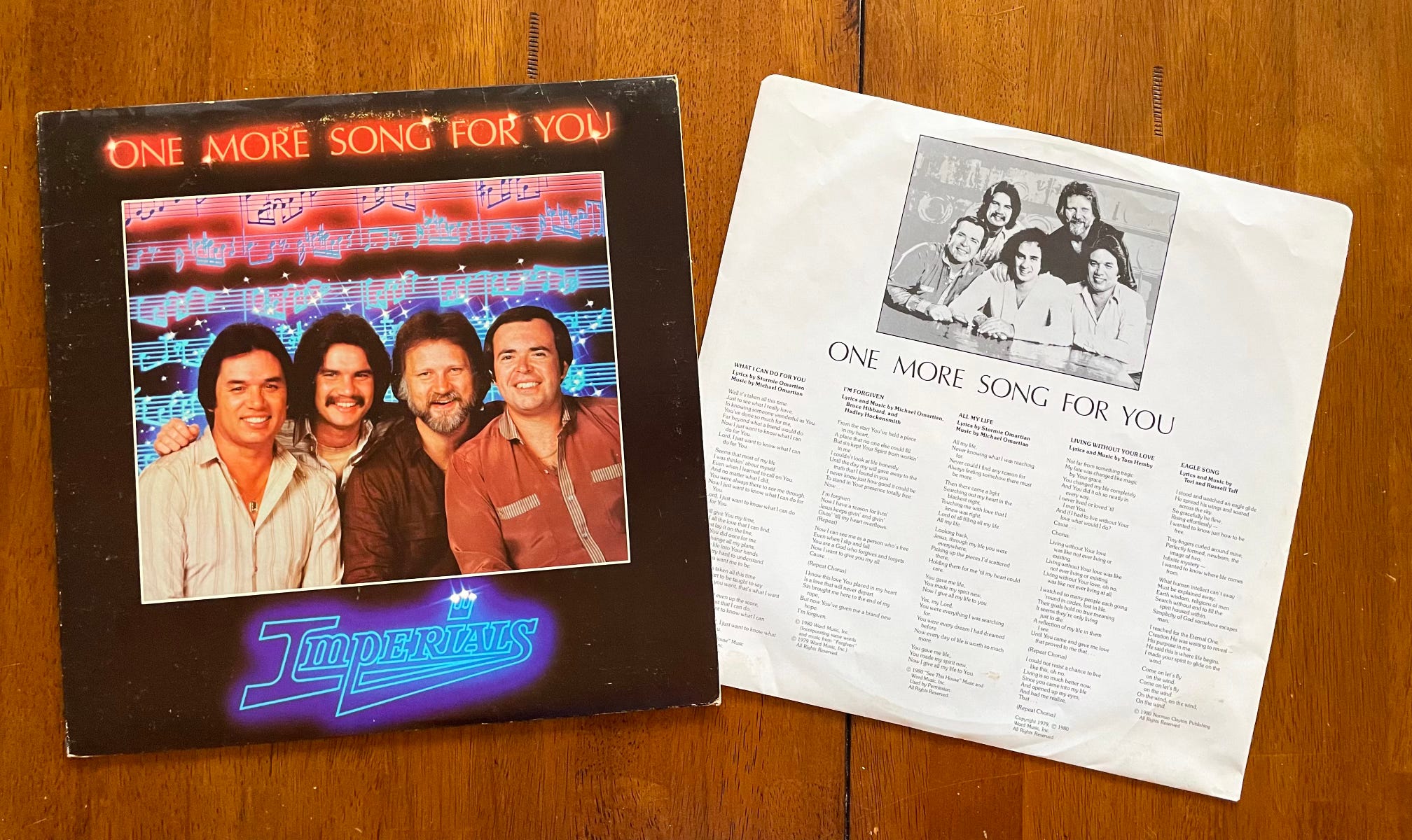
What a flashback it was playing vinyl again. The occasional crackle, watching the disc spin, reading the liner notes. I knew Michael Omartian had produced the album, but I didn’t remember that he and his wife, Stormie, had written five of the nine songs and co-wrote one other. Impressive. Russ Taff and his wife, Tori, wrote my favorite song on the album, Eagle Song.
There is no payoff to this story, just a lot of connectedness and passage of time. Such is life. See you next time.

A couple of my friends (older guys like me) have recently bought turntables. The sound quality is noticeably better than any digital format and it's kind of fun to be spinning records again. I'm tempted to get one myself but I have very few albums left at this point.
My LP's are long gone. I'm basically stuck in the 60's, 70's, and 80's. I got into outlaw country music in my drinking days. Still enjoy listening to those guys and Creedance and Steely Dan and The Rolling Stones... Thanks for the trip down memory lane, Mark. Merry Christmas!